
Corpus (Knowledge Base)
Comprehensive management of document collections and knowledge bases for RAG capabilities with AI agents in workgroups
Pro Feature: Corpus (Knowledge Base) management and RAG capabilities are available only in Pro version.
The Corpus page provides comprehensive management of document collections and knowledge bases created through RAPFlow flows. These knowledge bases can be consumed by agents created in agent workgroups, enabling powerful RAG (Retrieval-Augmented Generation) capabilities.

Overview
The Corpus page displays all knowledge bases created through RAPFlow flows, which can be consumed by agents in agent workgroups. This interface provides comprehensive information about:
- Collection names and their embedding models
- Document counts and upload details
- Organization-level access and management
Document Collections
This page displays all document collections created through RAPFlow flows, which can be consumed by agents in agent workgroups. This interface provides comprehensive information about:
- Collection names and their embedding models
- Document counts and upload details
- Organization-level access and management
Document Details Page
Clicking on the document count in any collection record navigates to a detailed page showing all files uploaded to that specific knowledge base.
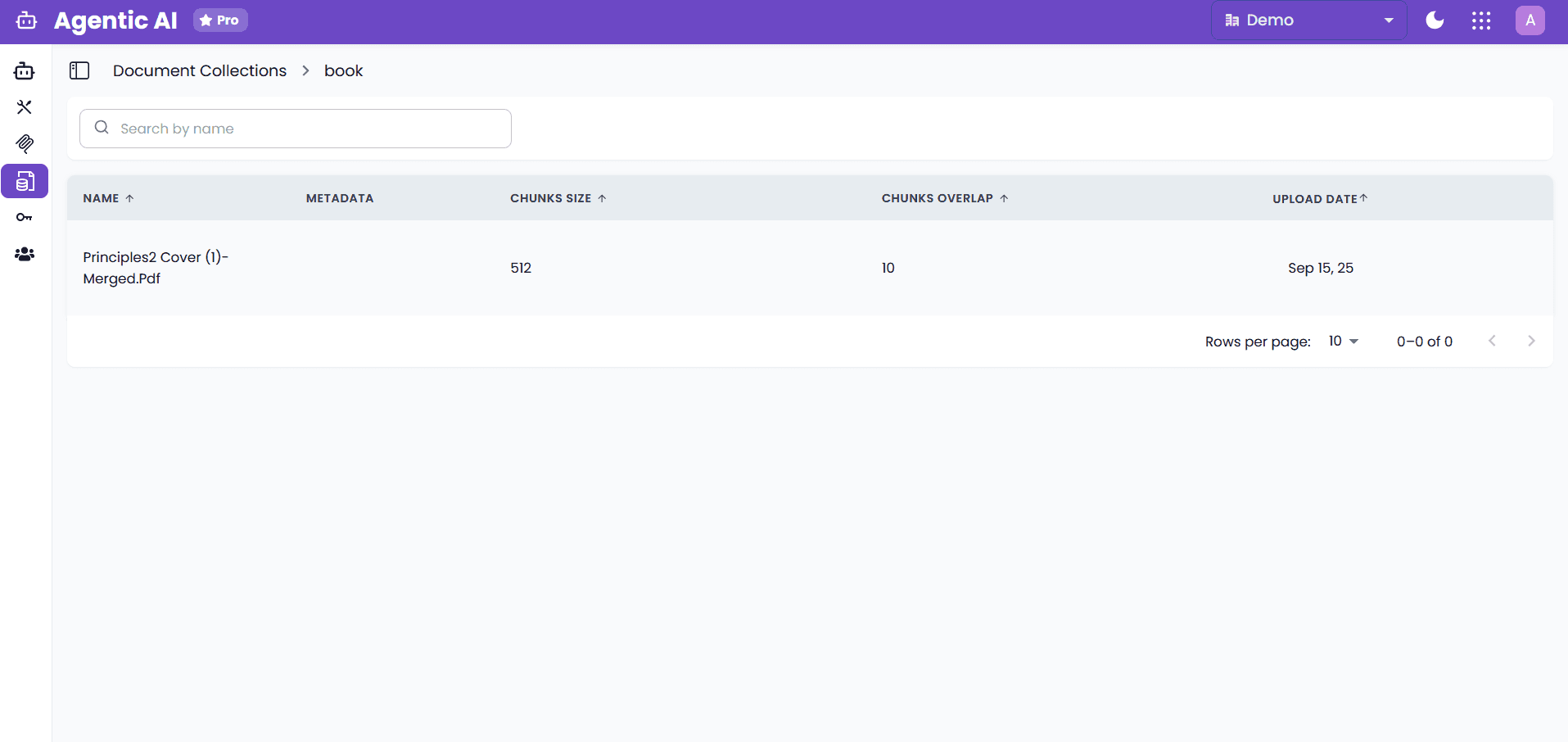
Document Information
The document details page provides comprehensive information about each file:
File Details
- File Name: Original name of the uploaded document
- File Type: Document format (PDF, DOC, TXT, etc.)
Processing Metadata
- Chunk Size: Size of text chunks used for vectorization
- Chunk Overlap: Overlap between consecutive chunks for better context
- Embedding Model: Specific model used for document vectorization
- Processing Date: Date and time when the document was processed
Use Cases
Knowledge Management
- Document Repositories: Store and organize company documents
- Research Libraries: Maintain research and reference materials
- Policy Documents: Store and retrieve policy and procedure documents
- Training Materials: Organize training and educational content
AI Agent Enhancement
- Context Provision: Provide relevant context to AI agents
- Knowledge Retrieval: Retrieve specific information for agent tasks
- Response Enhancement: Improve agent response quality and accuracy
- Domain Expertise: Provide domain-specific knowledge to agents
Best Practices
Collection Organization
- Descriptive Names: Use clear, descriptive collection names
- Logical Grouping: Group related documents together
- Consistent Naming: Follow consistent naming conventions
- Regular Updates: Keep collections current and relevant
Document Quality
- Clean Content: Ensure documents are well-formatted and clean
- Relevant Content: Include only relevant and useful documents
- Regular Review: Regularly review and update document content
Performance Optimization
- Appropriate Sizing: Keep collections at optimal sizes
- Efficient Indexing: Use appropriate embedding models
Integration with Agentic Workgroups
RAPFlow to Agent Workgroup Flow
Knowledge bases created through RAPFlow flows are automatically available for consumption by agents in agent workgroups:
- Knowledge Base Creation: Documents are processed and indexed through RAPFlow
- Agent Configuration: Agents in workgroups can access and utilize these knowledge bases
- Context Enhancement: Agents use the knowledge bases to provide enhanced, contextual responses
- Real-time Access: Agents have real-time access to updated knowledge base content
Agent Configuration
- Knowledge Base Selection: Select relevant collections for specific agents
- Context Configuration: Configure how agents access and use knowledge base content
- Search Parameters: Set retrieval parameters for optimal context matching